The appraisals, the market forecasts and the open homes can all wait a week.
Grace, who has spent fifteen years getting to what's really going on for people, shows you the question to answer first.
It's why the decision you make afterwards will feel right for decades to come.
“Grace helped me see that I was focused on finding the right property, when I actually needed to work out whether moving was right for me. She cut through the noise and helped me make a decision that genuinely fitted my life.”
“Grace gave me the space to think clearly without ever taking the decision away from me. She challenged my assumptions, asked the questions I hadn’t considered and helped me move forward feeling confident—not pressured.”
It's eleven at night and the app is open again. Nothing new since you checked after dinner. Your thumb keeps going anyway, because some part of you believes one more look will settle it.
Maybe you've had three agents through for appraisals. Each came with a different number and the same energy. Your brother has a view, your friend has a view, and the voice in your own head has been running the same lines for a year: "It'll do." "We can't afford it right now." "Plenty of people would be grateful for this house."
Then a quiet stretch arrives. Weeks go by, and you'd tell anyone who asked that you're not really looking. Then a rates notice or a friend's auction result starts the whole thing up again.
If this sounds familiar, you're not alone, and nothing about you is broken. You've been thorough. You asked sensible people sensible questions.
What's missing is something to sort all those answers by. I call it the gap between the reason you give for moving and the reason that's true. You say the garden has become too much. Underneath, perhaps the kids have gone and the house holds a life that's finished. All the advice you've gathered works on the first reason. The second reason is the one quietly steering.
It seems obvious that more information leads to a better decision. Median prices, clearance rates, school catchments, what interest rates might do. Gathering it feels responsible, and up to a point it is.
Then look at what's actually in the pile. It's all market information. Not one line of it tells you whether you want to be waking up in that house five years from now.
More information gives you more options, and more options make the decision heavier. The question that cuts through is a small one: what do I need to know for this particular decision? For most people that's a handful of numbers and one conversation with a broker. The other forty tabs are a way of putting off the part that feels uncomfortable.
Everyone you've asked has something riding on the outcome. I don't say that as a criticism. The agent is paid when something sells. The broker's job is to write a loan. Your family has feelings about what decision you make. Even the kindest friend, over a glass of wine, is protecting their own picture of a good life.
Each of them is competent, and each of them is answering a property question. Realestate.com.au and Domain tell you what it's worth. The agent tells you when to sell. Friends and podcasts tell you whether now is the time.
Nobody asks what this move has to do for the next ten years of your life. So you say "we need more space", and the whole industry, correctly and efficiently, goes and finds you more space. Six months later you're standing in a new kitchen, wondering why it feels exactly the same.
Nearly $300,000 of my parents' money went into a room I never wanted to be in.
My mother and father came to Hobart from Italy with a work ethic and not much else. I used what they left me to open a yoga studio for a community I loved. Setting it up felt meaningful. Running it was hard almost from the first week. The electrical faults kept coming back, and every hurdle had another one standing behind it.
Three or four months in, I said it out loud to myself: "I feel like I'm in a bad relationship and I need to get out." I stayed another two years. When I finally sold, it was for nowhere near what went in.
Later I sold my house on bridging finance, in a hurry, with an agent I'd trusted on the strength of a handshake. They knew what every delay was costing me, and they used it. That sale cost me somewhere between eighty and a hundred thousand dollars. It also cost me a good piece of my self-belief.
When I sat with all of it afterwards, one thing stood out. Across both decisions, through months of conversations with capable professionals, not one person asked me what I wanted my life to look like. I'd spent fifteen years helping other people see the gap between what they say they're doing and what's really going on, and I'd missed it in myself twice.
This is the book I wish someone had handed me before I signed that first lease.
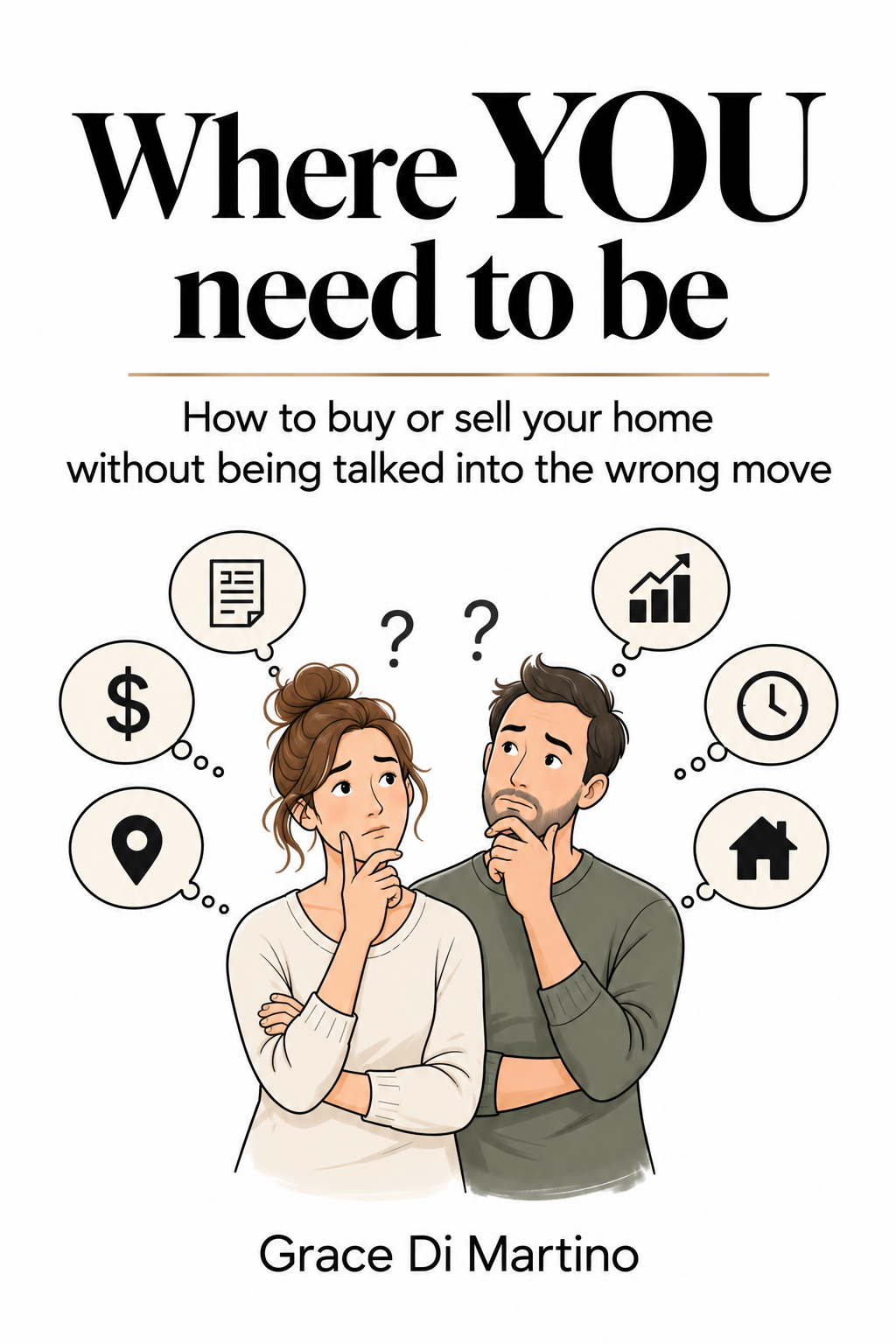
When you decide where your life needs to be before you look at property, each listing and each offer becomes something you can check calmly, where before you would have agonised over it.
This book walks you through four questions. Who needs to be near you, and how near? What do your mornings look like on an ordinary weekday? What money has to be left over when it's all done? And what are you finished with?
The word I keep coming back to is need. Want is negotiable, and someone will always be happy to negotiate it for you. Need keeps the list short and honest, and nobody can talk you out of it one item at a time.
My mother taught me this before I had words for it. Not long widowed, she looked at a new townhouse near home: flat block, no stairs, nothing to fix. The family agreed it made sense. A few days later she told me, "I feel like a bird in a cage." She stayed in the house with the garden, and she had fifteen more years of vegetables, fruit trees and jam.
Want is negotiable, and someone will always be happy to negotiate it for you.
The CLEAR Move is the four-step method at the centre of the book. Every other professional in your deal works on the transaction.
The CLEAR Move works on YOU, the person doing the transacting, so you can sit across from any agent, broker or solicitor and know whether what they're proposing gets you closer to where you need to be.
You'll need about ninety minutes, a pen, and your own kitchen table.
The 4 steps to a property decision you'll stand behind.
“Grace understood that selling my home was about far more than property. She helped me work through what was changing in my life and gave me the clarity and confidence to decide what came next.”
“Grace helped me look beyond bedrooms, suburbs and property prices and think about how I actually wanted to live. She helped turn a confusing property decision into a much clearer next chapter.”
“We knew we wanted to downsize, but we weren’t sure what we were actually moving towards. Grace helped us look beyond the property itself and focus on the lifestyle, freedom and priorities we wanted for the next stage of our lives.”
Kay and her partner came in talking about agents. They'd spoken to several, and they took me through what each had said about the market, where the finances landed, and what the bank would and wouldn't approve. It was a tidy account. They'd clearly told it many times.
So I asked the only question I cared about: why do you want to sell this house? "It doesn't fit with us right now." I asked what that meant, in their house, on a Wednesday.
What came out had nothing to do with agents. They had children at home and ageing parents, and they were holding both ends at once. When I asked how all of that felt, one of them said, "I don't think I've ever been asked that before."
Over a few sessions, something released. They started talking into the issue instead of around it. They did sell. The difference was that they knew why, and the next question became what kind of home fits the stage of life they're actually walking into.
"We met monthly, and over time it became clear I was on the wrong path entirely. I'm now self-employed in Tasmania's tourism industry. Two years after the change, I hadn't had a single bad day at work, and my family life and health are better than ever."
"I've come away with an ally and a confidante. I've got someone in my corner"

Grace Di Martino grew up as the English speaker in an Italian migrant family. From the age of eight or nine she filled in government forms and rang offices for adults who couldn't ring for themselves. She learned to care for everyone else early, and she has spent a good part of her life learning to include herself in that care.
She began as a language teacher, then spent fifteen years in the federal public sector, rising to Executive Level. The part she loved most was sitting with one person and working out what was really going on for them. She is an accredited DISC ADVANCED® practitioner, teaches yoga and meditation, and has run a small accommodation business. She founded a yoga studio in Hobart and sold it.
Today she coaches people facing big life transitions. Her work now extends to property decisions for people whose relationship with their home needs to change because their relationship with their life has changed.
She has never sold a house for anyone and never will. She takes no commission, no referral fees and nothing from brokers, so it makes no difference to her what you decide. She talks things through out loud at home, and her dogs have long since stopped looking surprised by it.
Think about the next Saturday inspection. The agent mentions the solar panels twice. You have four lines on a folded page, and within a minute you know whether this house serves your five years or just feels good on a sunny morning. When his name comes up on your phone later, you answer calmly, thank him, and go and hang the washing out.
Six to twelve months after settlement, the boxes are gone and the quiet comes back. That's when you'll find out whose decision it really was.
This book is how you make sure it was yours.
A short pen-and-paper way to decide where your life needs to be, so every listing and offer has something clear to be measured against.